The Wolf Cross from Foss
A Late Viking Age silver pendant and three parallels from the Lake Mjøsa region
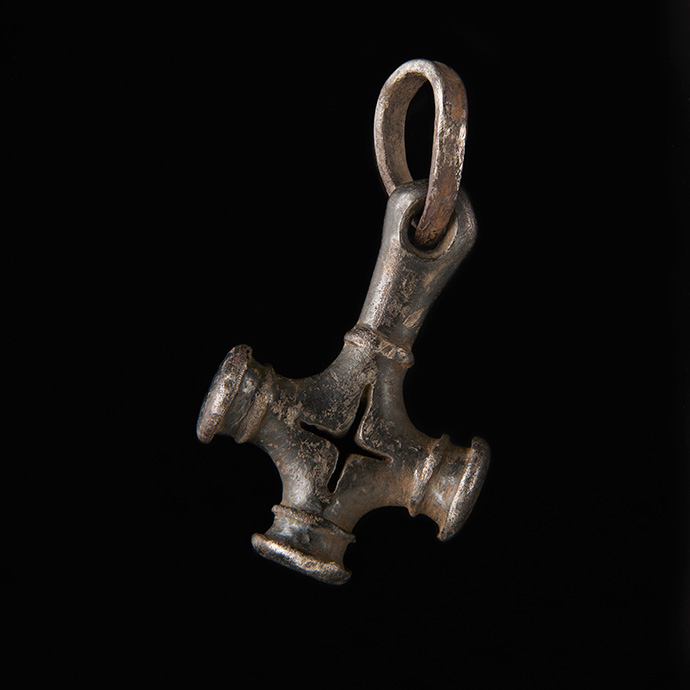
Around 1910, a small silver pendant came to light on the farm of Foss in southern Iceland (Gunnarsdóttir, 2001, entry ÁR-297:003). The National Museum of Iceland dates it to c. 950–1050 and describes the open mouth of the animal head as the point of suspension (Þjóðminjasafn Íslands, n.d.). The pendant has four arms and a cross-shaped opening in the centre (Gunnarsdóttir, 2001, entry ÁR-297:003). The animal head gave rise to the popular name “Wolf Cross”, although the species is uncertain. The debate concerns whether the object should be understood as a cross or as Thor’s hammer (Perkins, 2001, pp. 91, 107; Spangen, 2024).
What can this Icelandic stray find and three related silver pendants from the Lake Mjøsa region tell us about where the object was made? The finds make a connection with inland Norway plausible, but they do not establish where the workshop was or in which direction the design spread. The Museum of Cultural History identifies Nes in Ringsaker, Huse in Romedal, and Ven in Stange Vestbygd as the closest documented parallels. The animal-head suspension distinguishes the Foss example (Spangen, 2024).

A discovery around 1910
Foss is in Hrunamannahreppur, southern Iceland. The pendant is listed in the regional heritage survey as ÁR-297:003. The entry reproduces a local record of place names that locates the find more precisely within the farm’s grounds. A track ran from the farmstead towards Múlatúnið. Along the stretch in question, it passed through a sandy gap between two relatively high banks. The lower bank was called Sauðhúsbakki and the upper one Flagbakki. The find is associated with the banks and the sandy gap, where other archaeological material is also reported to have come to light. The place-name record dates the discovery to “1910 or thereabouts” (Gunnarsdóttir, 2001, entry ÁR-297:003, translated from Icelandic).
The place-name record describes the lower bank as partly eroded and later beginning to revegetate (Gunnarsdóttir, 2001, entry ÁR-297:003). Hogg (2015) describes the pendant as a stray find without archaeological context. It can therefore be situated in the landscape, while its position in any particular soil layer, grave, or other feature remains unknown.
The survey also mentions an axe reportedly found on a bare patch of ground at Foss. Both objects appear in the same entry, although it is unclear whether they were discovered at the same time or had lain together. A separate entry records two spearheads from the Foss area and explicitly states that they were found together. The pendant and axe have no equivalent documented association. Assigning the pendant to a burial assemblage or hoard would require further evidence (Gunnarsdóttir, 2001, entries ÁR-297:002–003).
The National Museum of Iceland catalogues the pendant as Þjms. 6077/1910-195 (Þjóðminjasafn Íslands, n.d.). The element “1910-195” appears to indicate the accession year and a serial number. On that reading, the pendant entered the museum’s collection by 1910. This is consistent with the early notice cited in the heritage survey, on pages 87–88 of the Icelandic Archaeological Society’s yearbook for 1911 (Gunnarsdóttir, 2001, entry ÁR-297:003).
The cross shape and the animal head
The pendant is made of silver and measures approximately five by three centimetres (Þjóðminjasafn Íslands, n.d.). Three arms have rounded, expanded terminals (Perkins, 2001, p. 107). The longest arm ends in an animal head whose open mouth serves as the suspension point (Þjóðminjasafn Íslands, n.d.). At the centre of the pendant is a smaller cross-shaped opening. The heritage survey suggests that this opening may once have held a fused filling (Gunnarsdóttir, 2001, entry ÁR-297:003).
The small cross at the centre and the cruciform outline are distinct features. Both matter when comparing this piece with other pendants, as does the way it hangs. The animal head is part of the construction because its mouth provides the means of attachment. When the pendant hangs from that end, three arms occupy roughly the positions of the two transverse arms and the lower arm of a cross. The suspension thus provides evidence about both the design and how the object could have been worn. These features can be described and photographed independently of any interpretation of the pendant’s religious significance (Perkins, 2001; Þjóðminjasafn Íslands, n.d.).
The animal head gave the pendant its popular name, “Wolf Cross”. The Icelandic survey uses a term that can be translated as “wolf’s head” (Gunnarsdóttir, 2001, entry ÁR-297:003). The museum’s English description refers more generally to an animal (Þjóðminjasafn Íslands, n.d.). The head is stylised, and there is no known visual or written context that would allow a more specific identification. Whether someone looking at it around the year 1000 would have recognised a particular species or a named mythological figure remains an open question.
Three comparable finds from the Lake Mjøsa region
The suspension helps explain why the Foss pendant has long been regarded as distinctive. As a pendant type, however, it has archaeological parallels. Marte Spangen of the Museum of Cultural History identifies three finds from Innlandet. They share a related cross- or hammer-like form, and all three lack the animal head characteristic of the Foss piece. Two are from Stange municipality, while the third was found at Nes in Ringsaker. The sites are close to one another around Lake Mjøsa. The group is small, and its apparent distribution reflects preservation conditions, methods of discovery, and what has been recorded to date (Innlandet fylkeskommune, n.d.; Spangen, 2024).
| Findspot and catalogue number | Material and dimensions | Find context or method of discovery | Suspension | Published date |
|---|---|---|---|---|
| Foss, Hrunamannahreppur (Þjms. 6077/1910-195) | Silver, c. 5 × 3 cm | Stray find, around 1910 | Open animal mouth | c. 950–1050 |
| Nes, Ringsaker (C65930) | Silver | Metal-detector find | No animal head | Late Viking Age according to the county authority. The museum gives 800–1050. |
| Huse, Romedal in Stange (C13216) | Silver, 3.6 × 2.3 cm | Burial mound | No animal head | Viking Age. The display case as a whole is dated c. 800–1100. |
| Ven, Stange Vestbygd (C59393) | Silver, 2.85 × 1.95 cm | Unspecified in the sources consulted | No animal head | Viking Age. The display case as a whole is dated c. 800–1100. |
The Foss entry draws on the heritage survey and the museum’s object information (Gunnarsdóttir, 2001, entry ÁR-297:003; Þjóðminjasafn Íslands, n.d.). The narrower date for Nes is given by the county authority (Innlandet fylkeskommune, n.d.). Details of the suspension and the burial mound at Huse come from Spangen (2024). The dimensions of the Huse and Ven pendants are given in Vikingtidsmuseet’s object list (2021), while the range 800–1100 comes from the exhibition booklet (Historisk museum, n.d., p. 22).
Nes in Ringsaker. Ole Harpøth discovered silver pendant C65930 by metal detecting on the Nes peninsula. The Museum of Cultural History notes that its form can be read as a cross or as Thor’s hammer bearing a cross motif (Spangen, 2024). The museum’s close-up allows readers to compare its outline with that of the Foss piece and see how the suspension was constructed. View the museum photograph of the Nes pendant.
Huse in Romedal. C13216 is the only one of the three Norwegian pieces documented as coming from a burial mound. Romedal is in Stange municipality. The find shows that a cross-shaped pendant of this type could be incorporated into a burial practice with roots in the Norse Iron Age. Assessing what the pendant meant in this particular grave would also require examining its placement and the other grave goods (Spangen, 2024).
Ven in Stange Vestbygd. C59393 is the smallest of the three pendants for which measurements are given in the table (Vikingtidsmuseet, 2021; Þjóðminjasafn Íslands, n.d.). The exhibition booklet shows the Ven and Huse pieces in the same photograph, labelled with their catalogue numbers. The juxtaposition shows that the type encompasses pendants with differing proportions. View Huse and Ven on page 22 of the exhibition booklet.
Foss for comparison. The National Museum of Iceland’s photograph shows the animal head and the relationship between the central opening and the four arms. The photographs in the three links are published by the museums and are shown at different scales. The table gives the available dimensions for comparison. View the Foss pendant in the National Museum of Iceland’s exhibition.
Christian cross or Thor’s hammer?
The Icelandic archaeologist Kristján Eldjárn interpreted the pendant as a Christian cross. He based his argument on its clearly cruciform shape, with four arms and rounded terminals on three of them. In his view, the Foss piece differed too greatly from known examples of Thor’s hammers for that designation to be convincing. Richard Perkins recounts this discussion in his study of the Eyrarland figure, another Icelandic object whose interpretation has been disputed. The Foss cross was brought into that discussion as a point of comparison. The two artefacts survive in different forms and offer different kinds of evidence (Perkins, 2001).
The National Museum of Iceland displays the Foss piece as “Hammer of Þór”, while the Museum of Cultural History presents both readings of the Ringsaker pendant. The difference in presentation reflects the fact that the typology still permits more than one reading. An interpretation as Thor’s hammer with a cross motif has to account for how the four arms and the opening form part of a hammer-shaped design. An interpretation as a Christian cross has to consider how much weight the overall outline and cross-shaped opening can bear, and how the animal head fits into the design. Eldjárn’s interpretation rests on features that can be examined directly, although the religious use of the pendant remains uncertain (Perkins, 2001; Spangen, 2024; Þjóðminjasafn Íslands, n.d.).
The Foss pendant can reasonably be described as a find from the period of religious transition. The museum’s date of c. 950–1050 encompasses Iceland’s adoption of Christianity around the year 1000. To argue that the object was deliberately designed to express a union of Christian and Norse beliefs would require a different kind of evidence. There is also no secure connection between the Foss piece and the Irish clerics mentioned in the written tradition concerning early Iceland. A possible model from the British Isles would have to be investigated through specific similarities in form, ornament, or manufacture. A general resemblance to a cross offers little basis for identifying a particular setting or workshop (Perkins, 2001; Spangen, 2024; Þjóðminjasafn Íslands, n.d.; Vísindavefurinn, n.d.).
Parallels outside Norway
In Sweden, a small equal-armed silver cross was recovered from grave Bj 968 at Birka (Historiska museet, n.d.). It provides a parallel for the use of small cruciform silver pendants in the Viking Age. The museum description records no equivalent combination of a cross-shaped opening and animal head. The Danish mould from Trendgården is relevant in a different way. It shows that the same tool could be used to cast crosses and Thor’s hammers as separate pendants (Nara to Norwich, n.d.). It provides evidence about craft practice, while the Mjøsa finds offer closer parallels in form.
The Yorkshire Museum describes a silver pendant found in Yorkshire with a small gold hammer inlaid into it (Yorkshire Museum, n.d.). This British example shows how a hammer motif could be incorporated into a composite pendant design. Its execution differs from the Foss piece, where a cross forms the opening in the silver. The Swedish, Danish, and British museum finds thus offer comparisons for individual features of the Foss pendant. The particular combination seen at Foss remains distinctive among them.
The closest visual resemblance outside these museum finds is a silver pendant listed as lot 0325 by the British auction house TimeLine Auctions. It has a cross-shaped opening, three oval terminals, and an animal head with the mouth serving as the suspension point. The catalogue explicitly compares it with Foss and refers readers to lot 400 from 21 February 2017 and to English Romanesque metalwork. The reference to the 2017 object could not be verified against an independent entry giving a findspot. The recorded provenance of lot 0325 begins on the British art market. Its place of sale is documented, while its findspot and place of manufacture are unknown. The close resemblance in form is worth noting, although it adds no secure British findspot to the distribution (TimeLine Auctions, n.d.).
What the finds suggest about origin
The National Museum of Iceland states that the pendant is thought to have been made outside Iceland. The exhibition page gives no grounds for that assessment (Þjóðminjasafn Íslands, n.d.). The Museum of Cultural History points to a specific reason to investigate a Norwegian connection. Three of the closest documented parallels in form have been found in the districts around Mjøsa (Spangen, 2024). This suggests that the form was known in the region. A local concentration provides evidence of use, while identifying a workshop requires evidence of production.
Lake Mjøsa lies inland, but the communities around it were part of travel and trade networks. The historical overview in The Mjøsa Assessment discusses the importance of waterways and the trade in iron, furs, and other resources from uncultivated land to the region’s prosperity (Barron, 2026, p. 20). A small silver pendant could travel with an individual or change hands between the interior and the coast. Such mobility makes a connection between Mjøsa and Iceland possible. No route is documented for the Foss pendant, and the concentration of finds leaves open whether a finished pendant travelled or knowledge of the design was transmitted.
The distribution is also shaped by where people search, what survives, and which finds are recorded. Spangen (2024) describes organised metal-detecting surveys at Nes and the many finds recovered there. Objects lying near the surface of cultivated land may be more readily discovered than comparable pieces in areas that have seen little searching. Huse and Foss illustrate two other ways in which objects entered the archaeological record: a burial find and an earlier stray find. In a group this small, a single new and well-documented discovery could substantially change the picture.
The available dates do not establish a sequence among the four pendants. Foss is dated to c. 950–1050 (Þjóðminjasafn Íslands, n.d.). The Ringsaker find is described as Late Viking Age (Innlandet fylkeskommune, n.d.). Huse and Ven appear in a display case covering c. 800–1100 (Historisk museum, n.d., p. 22). Even a more secure date for the burial at Huse would primarily indicate when the object entered the ground. It could have been in use before it was deposited.
Comparing casting traces and finishing could help establish how closely the methods of manufacture were related. Analysis of the metal could shed light on the origin of the silver. The Bedale hoard shows what such an analysis can contribute: measurements of trace elements and lead isotope ratios distinguished several groups of metal within the same hoard (Kershaw et al., 2026). Any result for Foss would have to be interpreted in light of the remelting, mixing, and trade of silver. The history of the raw material may differ from that of the finished pendant.
What the four finds tell us
The three Mjøsa finds show that the Foss pendant belongs to a group with several surviving examples. Their basic form is similar, while the animal-head suspension distinguishes the Foss piece. This combination of resemblance and variation allows a specific question to be asked about a possible connection with Mjøsa (Spangen, 2024).
Eldjárn’s interpretation as a Christian cross rests on features of the surviving object, particularly its four arms and rounded terminals (Perkins, 2001, p. 107). The museum’s dating places the pendant in the period around Iceland’s conversion to Christianity (Þjóðminjasafn Íslands, n.d.). What the design meant to the wearer and where the craftsperson worked remain open questions. The Norwegian concentration of finds makes a connection with Mjøsa a specific hypothesis. The archaeological evidence for it is the resemblance between the objects.
Note on sources
I was unable to access the detailed Sarpur entry for Þjms. 6077 or consult the original notice in the 1911 yearbook, pp. 87–88. The public exhibition page does not name the finder. The early documentation may still contain that information. I also found no published analysis of the metal in the Foss piece or technical study comparing all four pendants. The links lead to the photographs published by the museums. Permission to reproduce them in a composite figure has yet to be established.
References
Barron, E. S. (Ed.). (2026). The Mjøsa assessment: A comprehensive review of the current state of knowledge on the Mjøsa Lake System and its surroundings. NTNU. https://www.ntnu.edu/documents/1363533941/0/Mj%C3%B8sa_Assesment_Engelsk_digital.pdf/967b8b2f-97ae-fb69-9f0f-52d856ed2436?t=1773234205183
Gunnarsdóttir, S. (2001). Menningarminjar í Hrunamannahreppi: Svæðisskráning (Report FS136-01011). Fornleifastofnun Íslands. https://fornleif.is/is/reports/fs136
Historisk museum. (n.d.). Víkingr [Exhibition booklet]. University of Oslo. https://www.historiskmuseum.no/utstillinger/vikingr/dokumenter/vikingr-utstilling-handout.pdf#page=22
Hogg, L. M. (2015). Humans and animals in the Norse North Atlantic [Doctoral dissertation, Cardiff University]. ORCA. https://orca.cardiff.ac.uk/id/eprint/89412/1/2016hogglmphd.pdf
Historiska museet. (n.d.). Cross pendant [Collection entry, 107848_HST]. https://vikingar.historiska.se/object_details.php?e=no&l=en&object=5C31C401-19D4-469C-AAD5-F343F89EE413
Innlandet fylkeskommune. (n.d.). Fotosamling: Praktfunn fra Innlandet. https://innlandetfylke.no/tjenester/kulturarv/metallsoking/fotosamling-praktfunn-fra-innlandet/
Kershaw, J., Merkel, S., Woods, A., Evans, J., Pashley, V., & Chenery, S. (2026). The provenance of silver in the Viking-age hoard from Bedale, North Yorkshire. Archaeometry, 68(S4), S86–S106. https://doi.org/10.1111/arcm.70031
Nara to Norwich. (n.d.). Casting mold for 2 crosses and Thor’s hammer [Catalogue entry]. https://naratonorwich.org/object/1149442/
Nationalmuseet. (2022, May 11). Støbeform med thorshammer og kors [Collection entry]. https://samlinger.natmus.dk/do/asset/913
Perkins, R. (2001). Thor the wind-raiser and the Eyrarland image. Viking Society for Northern Research. https://vsnr.org/wp-content/uploads/2021/11/Thor.pdf
Spangen, M. (2024). Kors eller torshammer. In Detektor – glemte historier. Kulturhistorisk museum, Universitetet i Oslo. https://www.historiskmuseum.no/utstillinger/utstillingsarkiv/detektor/qr-tekster/
TimeLine Auctions. (n.d.). Viking age silver cross pendant with head of a beast [Auction catalogue, lot 0325]. https://timelineauctions.com/lot/viking-age-silver-cross-pendant-with-head-of-a-beast/247251/
Vikingtidsmuseet. (2021, December 16). Key objects [Exhibition document]. Universitetet i Oslo. https://www.vikingtidsmuseet.no/de-nye-utstillingene/key-objects-16.12..2021.pdf
Vísindavefurinn. (n.d.). Is there any tangible proof that there were Irish monks in Iceland before the time of the Viking settlements? https://www.why.is/svar.php?id=4802&lang=en
Yorkshire Museum. (n.d.). Adopt an object. https://www.yorkshiremuseum.org.uk/adopt-an-object/
Þjóðminjasafn Íslands. (n.d.). Hammer of Þór [Exhibition entry, Þjms. 6077/1910-195]. I Making of a nation: Heritage and history in Iceland. https://thjodminjasafn.is/en/syningar-og-vidburdir/thjod-verdur-til

The Wolf Cross from Foss
A Late Viking Age silver pendant and three parallels from the Lake Mjøsa region
My essay was written in a conversation with ChatGPT


No comments:
Post a Comment